Sunday, May 2, 2010
Tvøroyrar Bóltfelag (Faeroe Islands)
Tvøroyri lies on the north side of the picturesque Trongisvágsfjørður on the country's Southern-most island of Suðuroy, some two hours by ferry from the capital Tórshavn, and as such their snug 4000 capacity Sevmýri ground must hold claim to being one of the most remote grounds in a major European league. But the long trip would be worth it, as the surrounding scenery is just startling!
Winners of the Faeroe Islands Premier League eight times, they've recently slipped into the second tier, where they narrowly missed out on promotion back to the top flight in each of the last three seasons. There is however talk of merging Suðuroy's other two significant teams together, following TB's slide into the second level. Fans of TB, the recently formed FC Suðuroy - already subject of a merger between VB Vágur and Sumba - as well as third division outfit Royn Hvalba are rightfully up in arms about it all. Surely a side as historic as TB should be allowed to keep its identity, whatever its league position - and at the very least, it would be a crime if its famous black and white stripes were no longer seen on their beautiful island.
All photos © lays with the owners
Videos from YouTube. Underlying © lays with the owners of the clips.
Adelaide City (Australia)
Formed in 1946 as many Aussie clubs were by a group of Adelaide residents of Italian heritage, the team were originally called simply Juventus, before extending it to Adelaide Juventus in the mid sixties. Eleven years later they changed again to Adelaide City, finally losing their link to the Italian favourites, but keeping the black and white kit all the same. They are currently among the tops sides in the regional South Australian Super League, although they spent many seasons in the old National Soccer League, winning the title three times before it folded in 2004.
Towards the end of their stint in the NSL they became known as Adelaide Force, when the league's sponsors were trying to rock and roll it up a bit, but reverted to City when they chose not to move into the new rebranded and highly franchised A-League. Since their reversion to the regional league they have won the title four times off the bat, but as promotion to the A-League is invitational and not automatic they have not taken their rightful place back in the top flight.
Notable former players include the one time Coventry and Portsmouth striker, John Aloisi, former Chelsea, Swindon and Millwall hitman David Mitchell and the tragic ex-Norwich star Justin Fashanu.
In their 64 year history they have won an outstanding 17 titles at the various levels they have played, and surely if it were not for the curious politics of Australian football they have reclaimed their rightful place at the top table of their national league a long time ago.
All photos © lays with the owners
Videos from YouTube. Underlying © lays with the owners of the clips.
CD Nacional (Portugal)
Being only an hour and a half's flight from Lisbon, Funchal popular location for away fans, and their recently expanded Estádio da Madeira ground nestles in the plush wooded foothills of the mountains that surround the city. Their recent success has seen them reach the UEFA cup and its successor the Europa League on three occasions now, although their only significant success in these competitions was when they beat former holders Zenit Saint Petersburg in the knockout stages in August 2009.
Their ground, also known as the Choupana, holds a cosy 5132, despite its recent upgrading, and is unusual in that it has no stands behind its goals, favouring instead a big fence and some smashing views of the surrounding area. As you would expect with both teams coming from such a small island, their derby with Marítimo is a particularly rabid one, with a huge socio-political divide between supporters of the two clubs that practically divides the island. The more middle-class and upwardly mobile Nacional fans were in favour of the commercial expansion of Madeira while the more working class Marítimo wanted to preserve the land and culture of the island. As you would imagine, this has caused even more ill-feeling between between the two already diametrically opposed sets of fans in a passionate country.
Perhaps Nacional's most famous son is a local lad you may just have heard of called Cristiano Ronaldo. After starting out in the youth team of local amateur side Andorinha, he moved to Nacional in 1997, where he caused such a stir in his immediately pre-teenage years that Sporting Lisbon snapped him up as a twelve-year-old. I believe you probably know the rest of the story. So proud of their former youth star are they that they have named their academy campus after him.
They may be an unassuming club with a tiddly ground in an out-of-the-way location, but these Madeirans are a passionate breed, and harbour ambitions for bigger and better things.
All photos © lays with the owners
Videos from YouTube. Underlying © lays with the owners of the clips.
Montevideo Wanderers (Uruguay)
To this day they are one of only three clubs to have won the title unbeaten - the other pair being Club Nacional de Fútbol and Club Atlético Peñarol - known locally as The Two Bigs, the Uruguayan version of The Old Firm. They gained their name of Wanderers after the club's founders, the Sardeson Brothers, travelled to England and were excited to discover that Wolverhampton Wanderers has won the FA Cup. As they had no official kit, money or even a ground they felt that the description Wanderers suited them perfectly, so took it home with them for their fledgling club as a homage to Wolves.They continued to be one of their country's top teams, frequently touring outside of their country, until a financial crisis in the 1940s saw them sell all their biggest names, and since then they have struggled to remain competitive against the richer teams. They subsequently became a battling yo-yo club of some repute, winning the Segunda División Uruguay on four occasions. The mid-1990s saw them nearly go out of business, but their fortunes have seen an upswell in recent years. If they had gone to the wall though football would have lost one of its most lively sets of fans - Los Vagabundos.
Their Estadio Viera ground may not be the largest or most well kept in their league, but it's certainly one of the most atmospheric. Surrounded by plush parkland, and fringed by exotic vegetation that overhangs the open seating, the ground is a perfect stage for the lively Wanderers fans. Home games are a riot of flags and banners, will reems of streamers being thrown from the off, and full salsa bands playing for the whole game. The fans themseleves often arrive clutching their trademark black and white umbrellas, and are famed throughout South America as being one of the biggest party mobs on the continent.
And just lately they've had something to cheer about. Since they last found their way back to the top flight in 2000, they've been gradually consolidating, finishing fourth in the table last term. A club with that kind of loyal fanbase deserves a bit of success, so let's hope they soon return to the glory days.
All photos © lays with the owners
Videos from YouTube. Underlying © lays with the owners of the clips.
Friday, April 30, 2010
Club Sportif Sfaxien (Tunisia)
Founded in 1928 as Club Tunisien, the originally played in a rather eye- melting kit of red and green stripes. It took them another 34 years to realise that this really wasn't particularly nice, and changed their strip to the glorious black and white stripes in 1962 - the same time they changed their name to their current title. They were promoted to the top flight of Tunisian football in 1947, and there they have stayed, for the most part, ever since.
The club and fans alike are hard task masters, and despite their frequent success on the pitch, the team has got through a startling 30 managers in the last 20 years. Although I've not checked in the last few minutes, so that figure may have risen. Despite this rapid turnover of coaching staff, they've still reeled in seven league titles, four President's Cup wins, three CAF Confederation Cups, and were runners-up in the CAF Champions League in 2006, narowly missing out by a late second leg goal to the prolific Egyptian trophy hunters Al Ahly.
They also have had success in both the North African Cup Winners Cup last year, and the Arab Champions League, which they have won twice.
However, despite their great success on the field of play, they are perhaps even better known for their fans, and were among the first on the continent to employ elements of choreography to their pre-match fun. They finished fourth in Tunisian Ligue Professionnelle 1 last season, some distance behind the champions and all-time local record holders and fierce rivals Espérance Sportive de Tunis, but you can bet that the team widely known as The Juventus of the Arabs won't leave it too long before their next league triumph.
All photos © lays with the owners
Videos from YouTube. Underlying © lays with the owners of the clips.
Botafogo de Futebol e Regatas (Brazil)
Ten years later in 1904, a local football team called Electro Club was formed by a bunch of school mates during an algebra class. They chose their black and white striped strip because one of their number was an ardent Juventus fan. After one of their grandmother's complained that the name sounded a little silly, they quickly changed their name to Botafogo Football Club. They soon became one of the strongest teams in the city, winning the local championship many times in their first few years. The football club and the rowing club finally merged in 1942. Despite having the same team colours and hailing from the same part of town, it never dawned on them to pool their resources until a basketball challenge between the two. When one of the football club's members died suddenly after the game, the president of the rowing club (the famous Brazilian poet Augusto Frederico Schmidt) deemed that the two should club together in his memory. From then on in, they shared the same badge and the same general management. I told you nothing was simple in Brazil.
Until as recently as 1971 there was no national league in the country, because of its massive size the difficulty of travelling between the regions. So in that time, Botafogo played in a number of regional, state and invitational leagues and tournaments. Their most impressive record is in the Rio de Janeiro state league, which they have won a massive 19 times - plus another 27 other titles from a variety of regions - including one national league title in 1985.
The club has seen some of the most famous names in Brazilian football history grace its stripes. The names roll off the tongue like a fantasy league of greatness - Bebeto, Carlos Alberto, Jairzinho, Josimar, Nilton Santos. But the greatest of them - and in many eyes the greatest footballer of all time - was a little fella with wonky legs called Garrincha.
Manuel Francisco dos Santos was better known by his nickname - a local phrase meaning Little Bird. he was the first international superstar of Brazilian football, and dazzled the planet in their twin victories in 1958 and 1962. Widely regarded as the greatest dribbler in the history of the game, his success was even more spectacular as he was born with a series of birth defects, including a deformed spine, a right leg that bent inwards, and a left leg that was two inches shorter and curved outwards. That he could walk at all was fantastic. That he could play like and angel was nothing short of amazing.
Sadly he died almost destitute in 1983, a victim to the wicked alcoholism that had blighted his family. But despite all that, thousands of well-wishers turned up to his funeral to pay their respects to Alegria do Povo - the Joy of the People. They still fly flags with his face on at Botafogo. But had he lived in a more televised age he would be an international household name perhaps even greater than Pelé.
All photos © lays with the owners
Videos from YouTube. Underlying © lays with the owners of the clips.
Thursday, April 29, 2010
Traces of a Sharp-Shin
He hunts our feeders. When he is hungry he perches right on them, peering around for any bird who might be frozen to their sides or under their tops. 
He is not what most people would consider a welcome feeder bird, but he always makes me smile. I have spread this feast for him, and he gladly avails himself.
He is the king of the birds in our yard, a cruel despot in their eyes.
The traces of his presence are everywhere—in the dark flank of a cardinal, torn
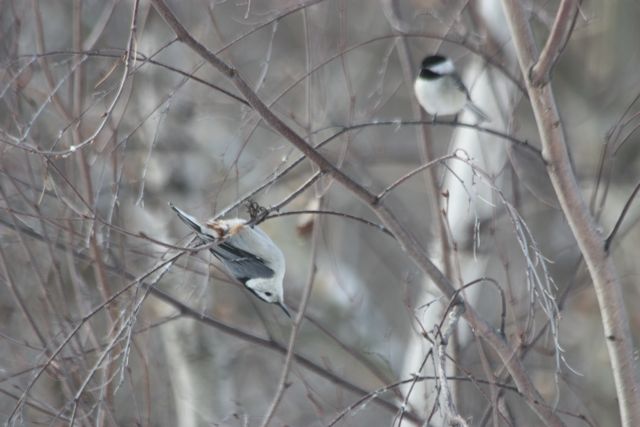
In the odd posture of a nuthatch, injured
who I no longer see around
And there’s nothing I can do about it but stop feeding
But to do that would be to lose the flocks I love so well
and send him hungry into the cold woods.
Spring is here and I miss him. I haven't seen him for weeks. Bill saw him April 25, circling over the east half of our land. Perhaps he is mated to the beautiful female sharpshin I saw carry a small package into the valley over which he circled. I hope he stayed.
I hear sharpshins calling from where she disappeared, on my morel-hunting slope below the big pines. Perhaps I’ll see him again when we’re moving slowly through the leaves, searching for pale honeycombed heads. The first ones came up April 21. We're hoping the gentle rains and soft ground will bring many more.


