Sunday, March 13, 2011

Examining an Armadillo

It was a huge treat to find a roadkilled armadillo the same evening, to be able to put my eyes and fingers on this creature and experience even more of it.


That shell is HARD! You can knock on it and it sounds like hard polystyrene. It was more like a turtle shell than the leathery cape  I'd imagined. Of course this specimen was pretty dessicated, but still, the shell was much harder than I thought it would be.


Such elaborate armor for the tail...does the tail have a function? I wonder. It looks like it could telescope out longer, but of course it doesn't. That would be cool, though...

What a marvelous integument this animal has; how specialized is its skin!

What a wonderful world this is.


Armadillos haul lots of dry grass and plant material into their deep burrows, making a cozy nest where they give birth to their four identical quadruplets right about  now (March/April). The young, born mobile and with open eyes, stay with their mom for most of a year, and then disperse. Armadillos can live about seven years in the wild and up to ten in captivity.


I cannot resist lifting some photos from an excellent overview of armadillos on Armadillo online. Because where else are you going to see babeh armadillos? With floppy wet leather, before their shells harden up?


But oh, they harden up fast.
Imagine how fast these razor claws could slice through sand in a rapid descent into the earth, with all four feet churning at once. I've read that they can just disappear in seconds in a big fluff of sand.


Even the top of its head is armored.


Back to the living armadillo: Before long a little crowd gathered, attracted by my crouching form. We all appreciated the armadillo together. I like being in a place where people habitually stop to admire wildlife. 

photo by Phoebe Linnea Thompson

The kids and I were thoroughly amused by the long golden hair on the armadillo's soft underside.


It's an unexpected detail, the mustache on the pretty lady, and it's very cute in real life.  Liam kept saying, "He's so HAIRY!!" I don't know why we expected him to be other thanhairy. Maybe it was the yellowness of it, or the length...it was just a surprise.

Thank you, little armored one, for interrupting your long nap and showing yourself to me and the kids. I owe you one.


Hey! It's a wonderful kind of day! Oh wait. Arthur was an aardvark, wasn't he? 

Thursday, March 10, 2011

Our First Armadillo


Warning: This post contains some roadkill photos. Heck, it's a post about armadillos. If it didn't mention roadkill, it wouldn't be about armadillos now, would it? Let's get that first DOA 'dillo out of the way:


There, that wasn't so bad. This poor fella managed to get himself killed in a beach parking lot. That takes some doing on both killer and killee's parts. Armadillos would be OK if they'd crouch down when a car passes over them, but instead they startle and jump straight up, bonking against the chassis and essentially commiting suicide. Armadillos are capable of leaping 4' straight up into the air, so you can imagine the forces when this power is applied to a speeding automobile.

I have always, always wanted to see an armadillo in the wild. Any armadillo (and there are 20 species worldwide, all but one of them in Latin America). In the southern US, we are blessed (or cursed, depending on who you ask) with a single armadillo species, the nine-banded Dasypus novemcinctus.

It's just so cool to have an edentate in the United States. "Edentate" means "toothless," though the nine-banded armadillo is hardly toothless. Here are the weird blade-like teeth of the hapless roadkill I found and examined in Florida. They stood up like an edge cut with pinking shears, more crenulations than teeth. Gross, I know, but look at the teeth, please.


Seriously: having an edentate in the US is like our having a flamingo, a spoonbill, an antelope, a lion. It's a lone representative of a cool order we might not otherwise have. D. novemcinctus ranges from Argentina to the southern United States, and it seems to have relatively recently colonized the US, having first been seen here in 1849. Armadillos naturally colonized Florida, but became extinct for unknown reasons. Modern Florida nine-banded armadillos are thought to descend from a pair that escaped from a roadside zoo about 50 years ago in Cocoa, as well as at least one earlier release. Knowing they aren't exactly "native," even if they were historically in Florida, seems to give some people license to hate them. Lots of people hate any animal that digs huge holes, so the cards are definitely stacked against the little armored one. Of all the world's species of armadillos, only the nine-banded has managed to thrive and extend its range. Go novemcinctus!

In deference to Floridians who will doubtless give me their $.02, it's easy to love an animal when it's not excavating your back yard.

But get this: The giant armadillo, Dasypus bellus, once ranged as far north as the Ohio River Valley!! No wonder I was so hot to see an armadillo, even if only its smaller cousin.


Armadillo Online is an amazing compendium of cool armadillo information. Like this: The nine-banded armadillo has a unique salivary bladder surrounded by muscle, a tappable reservoir of gluey saliva that it uses to snare ants, termites, and other insects as it eats.

Did you know that armadillos always have four young, and they are all identical, all the same sex and genetically alike? All four come from the same egg, which divides into four embryos. This makes them good lab animals, because where else are you going to get four genetically identical siblings every time? You've got your experimental animals and your control in one litter. However,  though they quickly become tame, they don't do very well in captivity.

They're also sought after and captured because armadillos can catch and carry leprosy, so a great deal of what we know about transmission of this disease comes from armadillo research. People go out with nets and catch 'dillos and sell them to labs. Unfortunately, people who handle a lot of armadillos sometimes get leprosy from them, yuccch. The armadillo has a weak immune system and an extraordinarily low body temperature -92 to 95 degrees, which is thought to make them susceptible to leprosy. Reason enough not to keep a pet armadillo!

Leprosy, a dreadful lesiony lumpy skin disease caused by the bacteria Mycobacterium leprae and M. lepromatosis, is now treatable with a multi-drug regime of rifampicin, dapsone, and clofazimine given over 12 months. However, the Third World still hosts leper colonies where people suffering from the disease are segregated--over 1,000 colonies exist in India alone. I flew over an island that's given over to people suffering from leprosy in Guyana, in South America. It's still part of the reality for many less affluent countries. That hit me hard, circling over that island just an ocean away from Florida, but decades removed in medical advancement. We are incredibly fortunate in the U.S. I try never to forget that.

Armadillos sleep up to 16 hours a day. Maybe this is why I'd never seen one until this trip to Florida. I've been all over south Texas too, but no go until now. As the kids and I headed to the beach one evening, I saw the trundling shape of my first 'dillo near a busy intersection. I whooped with joy and pulled over to document it.

photo by Phoebe Linnea Thompson

Absolutely beautiful it was, a perfect specimen.


I was impressed by its muley ears and perfect carapace; its birdlike snoot and tiny eyes. It spent 90 per cent of its time with its nose deep in the grass, looking for insects to eat, so I have dozens of photos but only a few where you can see its little eye. This is one of them.

More armadillo exploration anon.

Tuesday, March 8, 2011

Fun on Biolab Road


A young roseate spoonbill greeted us as we turned onto Biolab Road.  What an alluring name for a road!


                                This is what a black vulture does when it's really, really windy.

I like how he's using his tail as a brake, and he's clinging for all he's worth to the snag. Vulture feet are not strong in the clutching department, which is why they have to carry prey in their beaks.


Black vultures are a Florida fixture, and they call southwest Ohio their year-round home, but they're still pretty unusual to see in southeast Ohio, where we live. I have a feeling it's only a matter of time before they completely colonize my area. We have roadkill aplenty. You could live on roadkill around here, if you wanted to. Which I do not.

Bill had told me that Biolab Road was a must-see, and we were not disappointed. Phoebe said it led to the beach, and that seemed like a meet adventure for a mom and two cubs...drive down the road and wind up on Cape Canaveral's beach. We drove and drove, rolling slowly along, taking in the incredible wildlife along the way.


The kids loved the reddish egret, especially when I told them that birders call it the "drunken clown" for the way it staggers about in the shallows, following the lightning-fast movement of schools of fish which only it can see.


It throws out its wings for balance, making a spectacle of itself. To someone who doesn't know that it's fishing, it looks crazy, possessed, drunk.

And then it plunges its rapier bill straight down into the water to stab at little fishies.


 A far more placid feeding style distinguishes the roseate spoonbill. I felt incredibly lucky to be able to show this bird to my babies.


The spoonbills are more filter feeders, running that great appendage through the silt and snapping closed on whatever lives within.


They swing their great heads side to side, slowly sweeping through the shallows. 


They make pass after pass in an unconsciously lovely ballet.


Earlier in the day, we'd lucked upon a preening group of spoonbills along Black Point Wildlife Drive in Merritt Island NWR.  I quickly deployed the Leica scope and camera to digiscope their sickly green heads, ruby eyes and glorious crimson shoulders.


Could there be a much more convincing link between the dinosaurs and today's birds?


It was not much of a stretch to imagine duck-billed dinosaurs snapping to attention at the approach of a pack of Deinonychus, especially for Liam.


So long did we watch and admire the wading birds and snoozing gators that it finally became clear that we would never reach the beach before dark


and we decided that that was fine with us, because what could be better than this pastel sunset, with us all breathing the salt air, appreciating the heartbreakingly beautiful color. Color has been gone from our lives for months and months. We decided that all our color had drained down into Florida. We're very anxious to get it back, as rainy day follows rainy day and the crocuses struggle to bloom.


Phoebe snapped me in pursuit of egrets

and I snapped her in pursuit of sunsets


and it was all dreamily beautiful. We hated to see that sun sink, but it was kind enough to go behind some cutout palm trees, delighting Liam who thought it was time for the pterodactyl to swoop through, cackling, at any moment.


A snowy egret punched a white hole in the inky marsh as we said goodbye to another Florida day.


All landscape and car interior photos taken with  my Canon G-12, chunky little point and shoot genius box.

Sunday, March 6, 2011

Liam's First Alligator


I will not lie. Liam's first and main reason for wanting to go to Florida was not together time with his mom and sister, although he loves that. No, he wanted to see a ten-foot-long lizard. He really, really wanted to see an alligator. So from the moment we came in over the runway at Orlando airport, we were straining our orbs for eyebumps in every ditch and puddle. But it would be a couple of days before we got lucky.

Driving along Black Point Wildlife Drive at Merritt Island NWR, I finally spotted the prehistoric pile of scalage that said "gator" to my unaccustomed eye. It would have been hard to miss this one, hauled out as he was on a warm winter's day. Holy smokes!

It was all I could do to get Liam to take his eyes off it long enough to snap the photo of a boy with longing, for now, fulfilled.


We got out the spotting scope to get a better look at this dozing beauty.


I don't know why, but every time I see a dozing 'gator, my first thought is that it has hauled out of the water to die. They just look dead. When they close their eyes, the eye seems to sink back into the head, and they really, really look dead. You can't discern any respiration. A sleeping gator defines "inert."


Until the Science Chimp bleats like a little lost fawn separated from its mama and maybe about to try to cross the creek...oh, hello there. Sorry to bother you, but we didn't want our first gator viewing to turn into a wake.


Thus satisfied that the 'gator was quite alive and thinking about venison, we moved the scope so the kids and I could appreciate that armored tail. Dinosaurs live!


It was to be a wonderful evening for 'gators. We proceeded from Black Point to the alluringly named Biolab Road, where a molten sunset pointed up the scalation on three more beautiful gators.


It was really too beautiful and primeval to be believed. And these weren't babies, either. Liam's first  gator was the biggest--gettin' on 12 feet, we guessed. 


This one, maybe 9 feet...about the length of my canoe...eek! I wondered what it would be like to canoe around a beast like that. Maybe FloridaCracker can tell us. Does your heart race when one swirls under you? Heck, a big carp can scare the granola out of me, rocking my boat...what about a gator longer than your own conveyance??

I couldn't resist a shot of Firehair admiring this gorgeous animal.


Another...maybe 7 feet.

Another conservation success story. It's hard to believe we almost hunted the American alligator into extinction, just for the bumpy "leather" it lent to fancy purses and cowboy boots. It seems so archaic, so ridiculous to exterminate such a magnificent beast for things like that. It seems so...human of us. I grew up thinking I'd never see an alligator, or a bald eagle, or a wood stork...they were all but gone in the mid-1960's.

Endangered species legislation works. Alligators, bald eagles, and wood storks are back. Brown pelicans, too--they were once on the brink of extinction, as amazing as that seems. It's just too bad that so many truly endangered species are languishing in the Endangered Species Waiting Lounge, left unprotected because it's economically inconvenient to list them.

 How could we keep taking the tops off Appalachian mountains if the cerulean warbler that lives on them were finally listed as an endangered species, and we were legally bound to protect its habitat? Better not list that one. See, that's how it works. Once we saw what a powerful conservation tool the ESA could be, it was imperative to remove its teeth.

What if we had to legally acknowledge that polar bears and Pacific walruses are endangered because their pack ice habitat is melting out from under them? Legally they're listed as threatened, so we're not bound to do anything to reverse this deeply alarming phenomenon. They're in the waiting room, too. And what about the seals, mainstay of polar bears, that need the pack ice for pupping? Do we expect them and the walruses to simply switch overnight to hauling out on land? Who needs a bunch of pack ice? We don't. So what if they do? 

Having gotten a bit off track, I am thankful for alligators and the legislation that allowed their populations to recover. Well over a million alligators now populate the ditches and swamps of the Southeast.  And I'm deeply thankful that there are still places where you can take your kids to see the oversized scaly wonders of the natural world. 

See it while it's here, folks. 

Thursday, March 3, 2011

Happy Birthday, Bill!

I told Bill this morning I feel like a very lucky woman.

I get to share so much with him, and he makes it so much fun.

Photo by Mary Ferracci

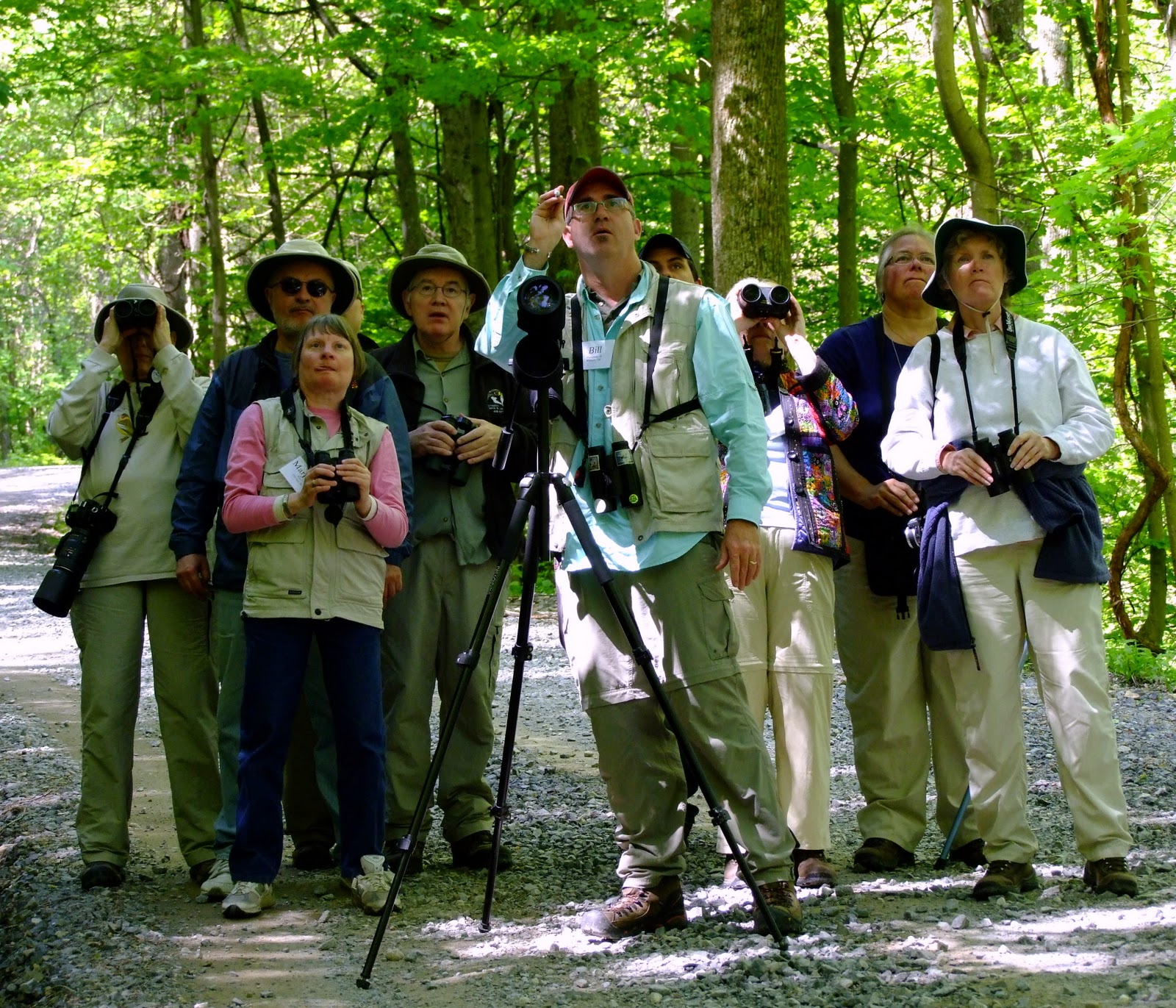
There's not much Bill likes better than getting people on a life bird. He's good at it, too. He chases down the beginners, wrests from unwilling lips their mumbled confession that they didn't really get a look at it that time, then makes sure they get a killer look at it the next time. He makes it his mission. You should see the smiles he brings.


Fun (and Connie and Claire and Anne and Ric and Kelly and Sara and Nina) seems to follow him wherever he goes.

Forget Pied Piper.  He's way cooler than that.

He's the Mack Daddy of birdwatching.

And then there's the full-blown Crowmance going on, the huge adventure of making our own music from the ground up with like minded souls, The Rain Crows.

Mr. Fez makes it happen.


He puts everything he's got into music, making sure everybody's on the same train. And when everybody gets on that train, look out, because it's going to go somewhere. He looks like he's relaxing here. Nope. Just planning his next move.


photo by Timothy Ryan

I dream of spring, when we can walk slowly down our trails, listening and looking at everything


and Bill can teach Liam, again, how to throw properly


with a backdrop of filmy green and sibilant warbler song


leaving me to marvel that this vessel of wonderful DNA is going to grow up big and tall, maybe even knowing how to throw with pinpoint accuracy like his Daddy

maybe not

but we all will have had fun in the trying and the growing.

I'm not saying the sun exactly shines out of Bill's posterior all the time


but on the whole he's a pretty awesome mega-chunk of humanity and 

photo by Shila Wilson

we feel mighty lucky to have him in our lives. Blessed, yes, that fits. Happy birthday, BT3. You are the bomb.

Tuesday, March 1, 2011

The Real FloridaCracker!


Sometimes you just know you're going to get along with someone. Reading a person's blog for years turns out to be a surprisingly good way to take their measure.  I don't remember how I got onto FloridaCracker's blog, Pure Florida, but the "crack" part definitely applied--I was hooked from the get-go.

The man can really write, and he's got a wonderful sense of humor, and he knows pretty  much everything there is to know about Florida natural history. He cooks, too, and posts these hugely salivataceous photos of his culinary adventures. He fixes things. He has a lucky wife known as Mrs. FC, who stays off-camera. He has chickens and teenagers, too.  He has a ridiculously cute black Lab named Bear whom he videotapes doing ridiculously cute, doofy Lab stuff. Here's his tribute to Bear, whom he manages to conjure perfectly without a single photo of the dog. Anyone who goes through pet withdrawal upon being separated from their particular animal familiar will love this post as I do.

In his spare time, he teaches high school biology. For that, I give him five stars. Imagine having FloridaCracker as your high school biology teacher. Mrs. Corbin, you were great, but whoo-ee.

This may surprise FC, but one of the things I admire most about him is his ability to raise a pig for food and blog about said pig (without naming it, of course). And have it still turn out to be food, and not some kind of porcine cybercelebrity whom he has to keep until it is the size of a boxcar because all his readers have gotten attached to it. Anyone who has ever blogged about so much as a spider in the corner of the studio knows that once you name something, the blogosphere wants to know how "Corky," or whatever you  named the spider, is doing these days. So blogging a food pig is dicey territory, but FloridaCracker pulls it off. That, my friends, is something.

He also coins words that completely delight me. I try, in my ham-handed way, to emulate him, but fail miserababbleaciously. 

He freely breaks the cyberspatial rules. I was told by no less an authority than Corey Finger of 10,000 Birds, a blog that gets something like, oh, 72 gazillion hits a day, that if you, as a craven hit-thirsty blogger, want to have search engines pick up on your posts, you have to use really spare, to-the-point post titles and tags. So, for instance, if FloridaCracker were going to talk about transplanting a palm tree, he might use the post title, 

"Transplanting a Palm Tree."

Instead, his post is titled, 


And then, needless to say, he puts a small camera on his head and it faithfully records his increasingly desperate groans and grunts as he lives the reality of lifting a hundred-pound rootball out of a deep hole. Who else would think to do this? I do not know.

His tag for such a post may well include 

The Boy Ain't Right


A recent post, "Gopher a Little Closer" , is about the endangered gopher tortoises (maybe a dozen) that inhabit his little piece of the Real Florida. There is an absolutely charming video of a gopher tortoise waiting suspiciously, then scurrying at warp speed into its burrow, or trying to. And FC finds a root that keeps the tortoise from entering smoothly, and he makes a little mental note to come out and cut that root. And then he leaves a bunch of nice romaine lettuce at the burrow mouth as a little present for the tortoise, who's already lucky as heck to be living in the backyard of such a sentient and caring being. He burns off the scrub to encourage the open habitat and the tender forbs the tortoises need for food. Anybody who can burn within a mile of their house without setting it on far has my undying respect. 


His JEEP looks like it just rolled off the showroom floor. Having never seen a clean Jeep before, I stared. Here, he's peeling a bit of plastic off the brand new windshield. Why a new windshield? Because a  vulture slammed into it a few weeks back, making it into this:

photo by FloridaCracker

Heavily ironic, because he'd just posted about planning his day around taking a sick black vulture to a veterinarian, which turned into a huge wild veterinarian chase. His post, "Riding in Cars With Vultures"
paints a portrait of a boy who ain't right, in the nicest possible way.

All right. My intent here was not to thoroughly embarrass FloridaCracker, which I have doubtless achieved, but merely to point up the front-loaded coolness with which he lives that made me completely geek out at the prospect of meeting him.

photo by Bill Webb

I mean, look at me. I'm all a-hyuck a-hyuck.

And then it got worse, because then I was flanked by FloridaCracker and CrackerBoy, whose unique take on the world as a socially evolved deep thinker and ex-cop I appreciate tremendously, and they made a big sloppy geek sandwich of me. Plotzing at the Enchanted Forest. Hooty hoot!


Like I said, sometimes you just know. I'm mighty glad to have met Bill and Michele Webb and FloridaCracker. This living through electrons is all well and good, but there's really no substitute for the brick-and-mortar version. 

photo by Bill Webb

To read FloridaCracker's take on the whole thing, visit his retelling here.