Sunday, March 27, 2011

Manatees, Breathing


It was absolutely hypnotic, standing on the dock at Blue Springs, watching the manatees loll in the 72 degree waters. 

They aren't there because they're on vacation. They're in the warm springs because they'd die if they were anywhere else. I was very surprised to learn that prolonged exposure to water below 60 degrees will kill a manatee. They seem sort of blubbery; they seem like they'd be well-insulated, but no...they're delicate tropical beasties and they have to be warm.  Wintry temperatures (it went down to the 20's a lot in much of Florida this winter!) send them packing to power plant outflows and natural warm springs. Warm springs are why only Florida boasts wild manatees, and only Florida will  ever have them. Another reason to love Florida. She gives us so many gifts. Gators. Flamingoes. Manatees.


They'd come up for air with a tremendous whoosh, a sonorous inhalation, then submerge again, shutting their little nostril valves tight.

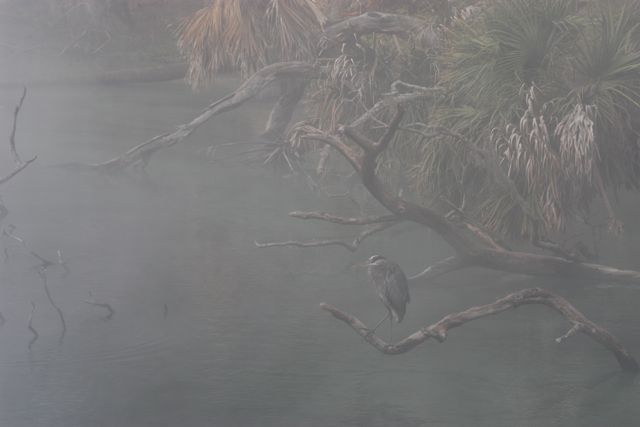
It was beautiful, standing there in the fog, listening to manatees breathing.

I tear up just thinking about it.


Ghostly tableaux one after another as the fog veiled through...sfffff whoooooof!


A lazy flipper or paddle-like tail would occasionally break the surface. I had to remind myself that these Schmoo-like creatures had bones.


Moving farther upstream, we came upon a mother and her calf. They were mouthing a rock, for what I couldn't divine. A nummy algal coating?


 The whole scene was magic, these big sweet beasts lolling around, placidly sucking on a rock, the palms catching the morning sun.


It was all I could do not to wade in with them, but they don't need more human contact. These are wild animals, and what humans mostly give them, aside from some lettuce and cabbage to eat and an occasional drink from a hose, is horrid white slashing propeller scars on their slow backs. More manatees die from boat collisions than any other single cause. The people who race through manatee zones are the same kind who shoot whooping cranes on purpose...society's filler, the soulless stratum, packing peanuts for brains.

 Manatees remind me of box turtles--just too slow for our inane and selfish pace. Somehow, they hang on.


This mother and child, as yet unmarked by scars. The older ones almost all have them.


All the while, the gentle whoosh of their breath breaking the stillness.


We could have stayed there all day with them, but our flight called and too soon we had to turn for home. You all know how I love Ohio, but I must confess she didn't show her best face as a biting 20-degree wind tore at our light tropical clothing at the Akron airport. Arrrgggh. Scrape the car free, get the heater blowing. Back to reality with a dash of ice in the face.


The whole trip floats like a dream in my head. I'll never look at Florida the way I did before I saw the Real Florida on this adventure. I'd made several trips to the Fort Meyers area, and I have to confess I was shellshocked by the crushing scale of development there. I never could have imagined living in Florida, with my pre-conceived notions of what it represented. And now, having experienced her wild places and met Floridians who love her passionately, even exploited and in some places ruined as she is, I understand. There is still a LOT of the Real Florida left, and Real Floridians are unstinting in their efforts to protect it.

 We are so lucky as a nation to have this funny footlike projection where, by dint of its subtropical climate, so much natural magic happens. Go. Just go. The Space Coast Birding and Wildlife Festival in late January is an excellent place to start exploring and, if necessary, renovating your feelings about FloridaCracker's "sweet, fragile Florida." For the most fun homework ever, get yourself reading his blog, Pure Florida. You'll thank me!

photo by Cap'n Denny

Don't worry. He let the redfish go. Well, this particular one. A guy's gotta eat.


Wednesday, March 23, 2011

I've Been Cooking a Book

OK, OK. I missed Sunday and Tuesday. What is it, Wednesday?

I've been busy.

See, in addition to blogging, I have a real job. And that job occasionally  has deadlines that I try to meet. All but one or two, I hit right on the head. But this was a big deadline. April 1, 2011. Have your next book done.

In self-flagellatory full-disclosure mode, I must add that the original deadline was April 1, 2009. Through Bad Time Management, Life Intervening, and a spectacular case of Mission Creep, I missed that'n clean.

This one, I made.

 25 chapters, 80,000 words, 320 pieces of art.  It works out to an illustration about every 650 words. 

Insane, I know, but I like to look at pictures, and I figure my audience does too. When I pick up a book, I flip through it back to front and if I like the pictures I'm much more likely to buy it. Ditto if there are lots and lots of pictures. I like pictures. About that Mission Creep...

This is what 320 pieces of art looks like in my studio. Each painting or drawing you can see has about ten more under it. Stacked art.


 It flopped over onto every flat surface. Sketches had to be torn out of the stacked sketchbooks; paintings had to be ripped out of the spiral-bound field notebooks. RRRRRIPPPP, arrgh.  I had to get used to that terrible sound when I did Letters from Eden, so it wasn't such a big deal to tear everything apart this time. As I ripped the pages, I repeated a mantra: Their highest purpose is The Book. Their highest purpose is The Book.

It helped.


Vultures and ospreys and mourning doves, hummingbirds and big woodpeckers, titmice and chickadees and bluebirds...26 species in 25 chapters, each one devoted to the strange and wonderful interactions I've had with these birds. Is it any wonder my entire studio is now taken up by flat files? There's a teeny little corner by the big windows where I create the things, but 90% of my floor space is storage. I'm like an Art Squirrel.


 Yes, that's Charlie in the lower right corner. The book ends with him, my avian familiar/succubus.


 Chimney swifts, Carolina wrens, starlings, swallows, phoebes, cranes, tanagers, sparrows, grouse, redtails. So many images, so many birds I have come to know. If I've studied them, managed them, thought a whole lot about them, fixed them or been their momma, they're in the book.


All the paintings had to be organized, catalogued, evaluated for insurance purposes, then packed into envelopes by chapter...

wrapped in plastic, taped securely...

packed into wooden crates, the top one made for me many years ago by someone very dear, and saved through the decades until it found its purpose once again.


 As I write, these crates are in a Big Brown Truck somewhere  between Columbus and Hartford, bound for the offices of Houghton Mifflin Harcourt in Boston. I hope my beloved editor Lisa White has a Phillips head screwdriver in her office, 'cuz she's gonna need one. Meanwhile, I've been neurotically checking their progress online, using tracking numbers and UPS's web site. They never call, they never write...you'd think they could text me once in awhile.

Yes, I've been cookin' up a little something for you. It's got to bake now for about a year, but come next spring, the Marsh Crone**  will start to brew again, and you'll sniff the air and know that the book is here.


By then, we will have settled on a name for it. It takes a village, you know. I have to have something left to procrastinate over, right?


Actual Zick outfit, captured by Bill of the Birds: RainCrows hoodie and purely redonk KMart apron, bought for Phoebe the Kitchen Elf. Afraid I've let fashion slip a bit further than usual while I've been working, too. Cackle!  Oh, and look. I have a hunch-backed assistant, and there's The Bacon in the lower right corner, hoping I'll drop a piece of chicken.

Cross your fingers for their safe delivery, sometime Thursday afternoon. 
And thanks for your good wishes.

UPDATE: 12:41 PM Wednesday: Departure scan, New Staunton, PA. 12:42 PM: In transit to Boston. Squee!

**from my favorite book ever, The Marsh Crone's Brew by Ib Spang Olsen

Thursday, March 17, 2011

The Curious Manatee


We're at Blue Springs State Park not far from Orlando, Florida, watching gators and manatees lie down and laze together in the heated water. It was all I could do not to wade in and get me some manatee love, but that's frowned upon. I did enjoy watching the Plecostomus catfish giving the manatees algae-suckin' rubdowns with their big sucker mouths, something the manatees appeared to be electing to invite by swimming down into the big concentrations of fish. The catfish obligingly worked them over, cleaned them up, just like my old Pleco used to clean up the aquarium walls.


A juvenile manatee swam in from stage right, wearing a belt at the base of his tail. Attached to the belt was a buoy with a radiotransmitter on it. One of the regulars on the observation dock said that this was an injured animal that had been rehabilitated at Sea World, and released with tracking, so they could see how he did. Cool!

We weren't the only ones who noticed the float. A much smaller juvenile manatee swam over and began fooling around with the float. First, she (I didn't know the animal's sex, but it just seemed like a girl thing to do) gathered it in her flippers. She held it underwater and released it, to see how it bobbed right back up.


Boing! She did this a number of times.


It was time for further exploration. She began to mouth the float.


The kids and I laughed to see her mess with it. Meanwhile the tagged manatee lay sullenly on the spring bottom, probably wishing someone would relieve him of this annoyingly fascinating appendage.


It wasn't long before the baby manatee got the whole darn float in her mouth. We wondered if the biologists who attached the transmitter knew it was going to be chewed upon by manatees.


When the baby tired of playing with the float, she went and got her momma, who repeated the entire exercise, even down to practically swallerin' the thing.


I apologize for the low quality of these photos. It was foggy, and the animals were very far away and underwater at that. But I was pleased to capture a little of the manatee way of doing things with the 300 mm. Canon telephoto zoom lens. 


Lots of people love manatees. Curious, gentle, sweet...those are the adjectives you hear over and over when people try to describe the sirenian personality.

I'm glad we've not exploited our native manatees for marine shows. It  probably has more to do with a manatee's decidedly non-flashy, rather blimplike appearance and way of moving than any sort of ethics on our part.


As the white propeller scars on these animals attest, they come into more than enough contact with us and our doings as it is. I'm thankful for preserves like Blue Springs, where these sweet dirigibles can come to spend the winter, warm and relatively undisturbed. And we can come to tell them we love them.
And the people gathered on the observation dock did love them. You could feel it, and I'm sure the manatees could, too.


Tuesday, March 15, 2011

Blue Springs Manatees


High on our agenda for our Florida trip was a visit to Blue Springs, a bit west of Orlando.  This is a classic limestone (karst) spring, carved out by upwellings of sweet water.  We devoted our last morning to it, as a sweet cherry atop the luscious sundae Sunday of our trip. It was cold and foggy when we arrived, making us envy the manatees stacked like cordwood in the pellucid 72 degree water of the river.  My first wild manatees, anywhere. Yes, I'd seen the Amazonian freshwater manatee in Brazil and Guyana, but only in captive situations. Heck, I'd gotten right down and hugged them!

I was overwhelmed by seeing free-living wild manatees--so very many--I counted 80 in one turn of my head! Yeah, yeah, I was bawling. I'd waited a long time to see my first wild sirenians, and I'd strained my eyes peering into the muddy waters of many a tropical river trying. This was too easy. It was like they were waiting for a bus, and the bus was us!


While we waited for the fog to clear, we looked beneath the observation dock. Some native Florida gar joined a snook, hanging as if on strings in the water. My GarGuru, FloridaCracker, advises that there may be two species of gar here, so he advised me to go against my Science Chimp instincts and not get too specific. 


The spring was almost choked with tilapia, an African escapee from fish farms. They're cichlids, related to those darlings of freshwater aquaria. Pretty good eating, but it doesn't look like we're going to catch up with their reproductive rate any time soon. Sigh. Fortunately (or unfortunately for Blue Springs), tilapia are confined to waters that stay above 60 degrees year-round, meaning that (so far) only Florida has to deal with them, and, outside of extreme southern Florida, generally around power plant outflows.

Farm-raised tilapia fed on corn may be fattier than bacon or hamburger. (Remember when everyone found out that the fish sandwich at Mickey D's is the worst thing you can order? That was because of the way they fry it, though.) And,
 interestingly enough, commercially farmed tilapia are subjected to testosterone baths as young fry, turning them all into males. In this way, pisciculturists can ensure they raise an even-age batch of harvest-sized fish, rather than having to sort the offspring of their inevitable pairings. These look pretty even-aged to me--where are the juveniles? Dunno.

FloridaCracker says tilapia make huge, meter-wide bowl-shaped nests, crowding out native sunfishes. Bah. Why do so many escaped exotics have to live so darn large?

Tilapia have made it to the International Union for the Conservation of Nature's 100 World's Worst Alien Invasive Species, having been introduced into tropical waters all over the planet.  They're the big boxy gray fish in this photo.


The blackish banjo-shaped catfish are vermiculated sailfin catfish, native to Amazonia and known in the aquarium trade as Plecostomus catfish, or "plecos." One guess where those came from. I'll give you a hint. When I was a kid, I had one in my tiny 5 gallon aquarium along with the mollies and platies, and it got about 8" long so we gave it to the neighbors, who flushed it down their toilet when it got too big for their 20-gallon tank. Never give anything to your neighbors if you care about it.

In an Amazonian fish market in Manaus, Brazil, I saw Plecostomus catfish for sale, stacked like firewood, upside down, their sucker mouths gasping for air. They were about a yard long. I felt bad about that for years until I saw these.

Why do we import things like this, to put in little tanks and then, when they no longer fit in the tanks, to put in our crystal springs, where they dig the sides out and erode them, making their nests? Why do people keep Burmese pythons and then, when they're too big for the  apartment,  turn them loose in the Everglades, to proliferate to terrifying levels? That's just what we do. Dumb stuff like that. Genies get out of bottles and there is no stuffing them back. Especially when the genies like Florida's subtropical climate.

There were other creatures in with the manatees, which caused the big sirenians no concern whatsoever.


This was the youngest gator we saw, still carrying its banded tail.
It was about two feet long.


Even the big gator seemed not to carry a threat to the gentle mammals, who cruised right under it.


Blue Springs State Park is a magical place. Just the original homestead with the new sun beaming through its Tillandsia-draped tree...oh my goodness. We didn't have time for the house tour. Well, anyway, the Science Chimp can rarely be found on historic house tours--she's usually digging around in the leaf litter instead.


We had only one morning, this misty morning burning off to bright sun, before we had to go back to freezing, iron-gray Ohio.


We soaked it up as best we could.  More manatees anon!

Monday, March 14, 2011

The Crane Battle Moves to Kentucky


I cropped off the heads, with their big grins. Hunters tell me it's not hard to get your daily limit with such a huge, slow-flying target. 

We now interrupt our regularly scheduled inspection of armadillo carcasses with this important action alert for wildlife enthusiasts everywhere.  MARCH 15, 2011 is the deadline for public comment on a proposal to hunt sandhill cranes in Kentucky. That's TOMORROW. If you wrote to Tennessee in the campaign this winter, you can cut and paste and change "Tennessee" to "Kentucky." If not, please read my letter, crib bits of it in your own words if you wish, avoiding overly sentimental or confrontational wording,  and politely email Mr. Gassett at this address:    jon.gassett@ky.gov


Copy your letter to FW_Suggestions@ky.gov


Do it now, please, for the cranes. We fought them back in Tennessee; there's a two-year stay on their proposal. We can fight them back in Kentucky, too. The Kentucky Ornithological Society and the Beckham Bird Club have both come out strongly against the hunting season.  Kentucky Dept. of Fish and Wildlife Commissioner Jon Gassett has indicated that if enough people write in protest, the proposed hunting season--due to start this December-- will be reconsidered. Nobody owns these cranes--they're free for all to enjoy. If you think it's wrong to shoot them, please take the time to email Mr. Gassett. THANK YOU!


March 14, 2011

Kentucky Department of Fish and Wildlife 
Jon Gassett, Commissioner
 One Sportsman's Lane
 Frankfort, Kentucky 40601

Dear Mr. Gassett,
I am a writer, naturalist and artist with a special interest in human/bird interactions.
 For my new book, due out in 2012 from Houghton Mifflin Harcourt, I’ve been researching sandhill crane hunting. The sandhill crane has the lowest recruitment rate (average number of young birds joining a population each season) of any bird now hunted in North America. Historic recruitment rates of all migratory sandhill crane populations range from 7.5% to a high of 11%.

 Since 1975, hunting in the Central Flyway has taken around 20,000 cranes annually (E.M. Martin, U.S. FWS report). This represents 6% of the estimated mid-continental spring population of 322,700 birds for the same two decades. Given the projected recruitment rate, harvesting 6% of the population each year in the US alone seems to me to be cutting it too close to the edge. Kills in Canada, Alaska and Mexico are not included in the count. What about all the other birds that die from inexperience, disease, natural predation and accidents? Further, the crane take in Mexico is a free-for-all: neither regulated nor recorded.

 Hunting sandhill cranes in Kentucky is a bad idea from a public relations standpoint, considering the growing cadre of birders and nature enthusiasts for whom cranes are a touchstone species. How can Kentucky possibly garner enough revenue from crane hunting to offset the outrage when birdwatchers find out that the cranes they love and travel to see are being shot? Hunting is on a steady downturn, and nonconsumptive wildlife pursuits are on a tremendous upswing. Nationwide, wildlife watchers now outspend hunters 6 to 1. The explosion in digital photography allows people to stalk wildlife without harming it. Initiating a hunting season on a large, charismatic species like a crane is no way to resuscitate hunting. It is, however, an excellent way to alienate nonconsumptive wildlife enthusiasts, and further polarize the camps.

 Texas and North Dakota together account for 88% of the total yearly kill of sandhill cranes. There is evidence that a unique Canadian prairie population of lesser sandhill cranes is being selectively wiped out, since they migrate over the most heavily hunted areas of Texas. It should go without saying that the incidental kill of endangered whooping cranes is an unacceptable cost of adding another state to the shooting gallery all along both species’ migration route. Of the Central Flyway states, Nebraska alone holds out in protecting the cranes, having proven by its longstanding Festival of the Cranes in Kearney that a crane is worth infinitely more alive and purring in the sky with its family than thudding, broken and bleeding, into a cornfield.  Just ask Bill Taddicken, director of the Lillian Annette Rowe Sanctuary on the Platte River in Kearney. Crane tourism brings that little town around $10 million each year in revenue, without a single shot being fired. 

Proposing a hunting season on a bird with that kind of ecotourism potential simply doesn't make sense. Giving a few hundred hunters something else to shoot, in my opinion, cannot be worth the blowback from tens of thousands of people who are willing to travel and spend just to watch the birds fly over.  Please reconsider this proposal, and consider taking a lesson from what happened in Tennessee. Letters and emails by the thousand poured into the commissioners' offices, protesting its crane hunting proposal. Even more telling, the support the Tennessee Wildlife Resources Commission was expecting from its hunting community simply never materialized. I've received letters and emails from a number of avid hunters who find the concept of shooting cranes repugnant. TWRC's response to the outcry was a two-year stay on the proposed season. I feel certain that, given Tennessee's 18-year track record of celebrating cranes in a tremendously successful festival, the opposition will only be stronger in 2013. I would encourage the the Kentucky Department of Fish and Wildlife to take Tennessee's example as an indication that offering sandhill cranes for hunting will create far more public relations trouble than it's worth. 

Sincerely, 


Julie Zickefoose


Sunday, March 13, 2011

Examining an Armadillo

It was a huge treat to find a roadkilled armadillo the same evening, to be able to put my eyes and fingers on this creature and experience even more of it.


That shell is HARD! You can knock on it and it sounds like hard polystyrene. It was more like a turtle shell than the leathery cape  I'd imagined. Of course this specimen was pretty dessicated, but still, the shell was much harder than I thought it would be.


Such elaborate armor for the tail...does the tail have a function? I wonder. It looks like it could telescope out longer, but of course it doesn't. That would be cool, though...

What a marvelous integument this animal has; how specialized is its skin!

What a wonderful world this is.


Armadillos haul lots of dry grass and plant material into their deep burrows, making a cozy nest where they give birth to their four identical quadruplets right about  now (March/April). The young, born mobile and with open eyes, stay with their mom for most of a year, and then disperse. Armadillos can live about seven years in the wild and up to ten in captivity.


I cannot resist lifting some photos from an excellent overview of armadillos on Armadillo online. Because where else are you going to see babeh armadillos? With floppy wet leather, before their shells harden up?


But oh, they harden up fast.
Imagine how fast these razor claws could slice through sand in a rapid descent into the earth, with all four feet churning at once. I've read that they can just disappear in seconds in a big fluff of sand.


Even the top of its head is armored.


Back to the living armadillo: Before long a little crowd gathered, attracted by my crouching form. We all appreciated the armadillo together. I like being in a place where people habitually stop to admire wildlife. 

photo by Phoebe Linnea Thompson

The kids and I were thoroughly amused by the long golden hair on the armadillo's soft underside.


It's an unexpected detail, the mustache on the pretty lady, and it's very cute in real life.  Liam kept saying, "He's so HAIRY!!" I don't know why we expected him to be other thanhairy. Maybe it was the yellowness of it, or the length...it was just a surprise.

Thank you, little armored one, for interrupting your long nap and showing yourself to me and the kids. I owe you one.


Hey! It's a wonderful kind of day! Oh wait. Arthur was an aardvark, wasn't he? 

Thursday, March 10, 2011

Our First Armadillo


Warning: This post contains some roadkill photos. Heck, it's a post about armadillos. If it didn't mention roadkill, it wouldn't be about armadillos now, would it? Let's get that first DOA 'dillo out of the way:


There, that wasn't so bad. This poor fella managed to get himself killed in a beach parking lot. That takes some doing on both killer and killee's parts. Armadillos would be OK if they'd crouch down when a car passes over them, but instead they startle and jump straight up, bonking against the chassis and essentially commiting suicide. Armadillos are capable of leaping 4' straight up into the air, so you can imagine the forces when this power is applied to a speeding automobile.

I have always, always wanted to see an armadillo in the wild. Any armadillo (and there are 20 species worldwide, all but one of them in Latin America). In the southern US, we are blessed (or cursed, depending on who you ask) with a single armadillo species, the nine-banded Dasypus novemcinctus.

It's just so cool to have an edentate in the United States. "Edentate" means "toothless," though the nine-banded armadillo is hardly toothless. Here are the weird blade-like teeth of the hapless roadkill I found and examined in Florida. They stood up like an edge cut with pinking shears, more crenulations than teeth. Gross, I know, but look at the teeth, please.


Seriously: having an edentate in the US is like our having a flamingo, a spoonbill, an antelope, a lion. It's a lone representative of a cool order we might not otherwise have. D. novemcinctus ranges from Argentina to the southern United States, and it seems to have relatively recently colonized the US, having first been seen here in 1849. Armadillos naturally colonized Florida, but became extinct for unknown reasons. Modern Florida nine-banded armadillos are thought to descend from a pair that escaped from a roadside zoo about 50 years ago in Cocoa, as well as at least one earlier release. Knowing they aren't exactly "native," even if they were historically in Florida, seems to give some people license to hate them. Lots of people hate any animal that digs huge holes, so the cards are definitely stacked against the little armored one. Of all the world's species of armadillos, only the nine-banded has managed to thrive and extend its range. Go novemcinctus!

In deference to Floridians who will doubtless give me their $.02, it's easy to love an animal when it's not excavating your back yard.

But get this: The giant armadillo, Dasypus bellus, once ranged as far north as the Ohio River Valley!! No wonder I was so hot to see an armadillo, even if only its smaller cousin.


Armadillo Online is an amazing compendium of cool armadillo information. Like this: The nine-banded armadillo has a unique salivary bladder surrounded by muscle, a tappable reservoir of gluey saliva that it uses to snare ants, termites, and other insects as it eats.

Did you know that armadillos always have four young, and they are all identical, all the same sex and genetically alike? All four come from the same egg, which divides into four embryos. This makes them good lab animals, because where else are you going to get four genetically identical siblings every time? You've got your experimental animals and your control in one litter. However,  though they quickly become tame, they don't do very well in captivity.

They're also sought after and captured because armadillos can catch and carry leprosy, so a great deal of what we know about transmission of this disease comes from armadillo research. People go out with nets and catch 'dillos and sell them to labs. Unfortunately, people who handle a lot of armadillos sometimes get leprosy from them, yuccch. The armadillo has a weak immune system and an extraordinarily low body temperature -92 to 95 degrees, which is thought to make them susceptible to leprosy. Reason enough not to keep a pet armadillo!

Leprosy, a dreadful lesiony lumpy skin disease caused by the bacteria Mycobacterium leprae and M. lepromatosis, is now treatable with a multi-drug regime of rifampicin, dapsone, and clofazimine given over 12 months. However, the Third World still hosts leper colonies where people suffering from the disease are segregated--over 1,000 colonies exist in India alone. I flew over an island that's given over to people suffering from leprosy in Guyana, in South America. It's still part of the reality for many less affluent countries. That hit me hard, circling over that island just an ocean away from Florida, but decades removed in medical advancement. We are incredibly fortunate in the U.S. I try never to forget that.

Armadillos sleep up to 16 hours a day. Maybe this is why I'd never seen one until this trip to Florida. I've been all over south Texas too, but no go until now. As the kids and I headed to the beach one evening, I saw the trundling shape of my first 'dillo near a busy intersection. I whooped with joy and pulled over to document it.

photo by Phoebe Linnea Thompson

Absolutely beautiful it was, a perfect specimen.


I was impressed by its muley ears and perfect carapace; its birdlike snoot and tiny eyes. It spent 90 per cent of its time with its nose deep in the grass, looking for insects to eat, so I have dozens of photos but only a few where you can see its little eye. This is one of them.

More armadillo exploration anon.