Tuesday, April 12, 2011

Birds of Finca Paraiso


Everywhere I turned at Finca Paraiso, Honduras, there was something that took my breath away. Bougainvillea petals, fallen into a shallow reflecting pool. Probably something that needs to be cleaned out every few days. Oh, please leave them.

A fabulous jungle fowl, keeping an eye on his hens in the torch ginger plantation.


 But there was so much more than chickens and ginger here. This living logo is a crimson-collared tanager,  Ramphocelus sanguiolentus. Like many in that genus, its bill is reflective silver. Wish I could have gotten a better photo, but I wish that about almost every bird I shot in the rain. Some of those Ramphocelus tanagers have reds so vivid they hurt your eyes. There's the crimson-rumped tanager in the humid lowlands of Costa Rica that, when it flew up, made me yell WHAT THE HELL WAS THAT?? from my seat in a small plane coming in to land on the Osa Peninsula. Same kind of red as this one. Ow!


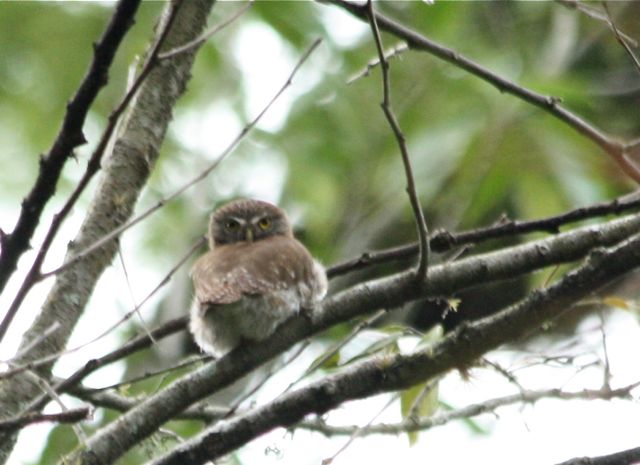
And, doubtless hoping to eat said tanager, a FEPO--ferruginous pygmy owl. Cute little buggers, they're death on songbirds. And the FEPO's monotonous tooting whistle, easily imitated, can bring in clouds of scolding birds.


Like many owls, they have a hard stare. This one reminded me of a hawk-owl that had gotten put in the dryer.

Oh, torch ginger. How I would love to grow you in my yard. I dug around and scratched the root. Yep, ginger. Mmm.

A collared aracari, Pteroglossus torquatus, or Belted Feathertongue in ZickLatin. It's a small toucan with weird greasy green, yellow and red plumage. Love those things, their springy hops and their crazy white goat eyes. They're tough on small birds, too--nest raiders. Toucans can be quite rapacious. 

I'm old enough to remember seeing aracaris in pet shops. Yep. Hideous, to see an aracari in a mynah cage, covered in its own feces, to hear that hollow bill clanging on cage bars. And more to celebrate, now that we know that's crazy, and we aren't legally permitted to do it any more. 


I'm not sure anyone has ever tried to put a motmot in a bird cage. Here's a turquoise-browed motmot, oh delightfully diademed one. Who thought up your jewelry, your sea-turquoise wings?


The motmot sits and waits for a katydid, lizard or frog to make the wrong move, then swirls down like gaudy death. I've found several motmots by hearing them bashing their prey, kingfisher style, against a perch.

Imagine living in a place where this fantastical being was a yard bird. No wonder they call it Finca Paraiso.

Sunday, April 10, 2011

Paradise Farm


Finca Paraiso: Paradise Farm. What a perfect name for this shade coffee/banana/cacao plantation not far from Lake Yojoa, Honduras.

Yes, it rained. It rained a lot while we were there, which made it tough to take decent bird photos, but oh! how I love the other photo ops it opened up. Flowers look their best in the rain, no? Yes, roses happily grow in Honduras. Told you it wasn't all that hot and humid, Possum. If a rose can grow there, you can go there.


There were so many flowers, and they all looked so lovely in the rain. Here's a heliconia, favorite of hummingbirds and relative to the banana, starting to open:


I am glad this is not a strict birding blog, (I don't do strict anything, come to think of it), because I was enchanted by the Gallus domesticus chuckling about in the rain.


They were cleverly taking shelter under the huge heliconia leaves. We were sheltering, too, in an open concrete shed, waiting for the rain to let up enough to go birding. It eventually did. With my telephoto lens and the flock of wet chickens, I had fun the whole time.


The high point for me? Seeing an heirloom bronze turkey hen running off with a stolen tortilla.


One reason to enjoy travel in Latin America is seeing the pure heirloom varieties of farm animals at the little fincas. You'll never see those big ungainly white turkeys that are the norm in America. They'd never survive the truly free-range living conditions in Latin America, where it's every turkey for himself, and damn the tortillas.

This one's for DOD, who loved to travel, but never made it to Latin America. He sure stomped all over America, though, and boy, did he have stories to tell. Miss you, miss you, miss you.

Thursday, April 7, 2011

Best Birding Boardwalk Ever!

From Hotel Las Glorias on Lake Yojoa, Honduras, it was but a short jaunt to Los Naranjos Archaelogical Site, an ancient Lenca Indian ruin that has been developed for ecotourism. A French non-governmental organization (NGO) built the bitchinest concrete piling and wood boardwalk I had ever seen. It wound for blocks and blocks through a flooded tropical forest, and it was absolutely popping with birds.


How inviting is that? You could walk silently on it without getting your feet wet or stepping on a viper. It was like being in a tropical bird museum.


A squirrel cuckoo peered silently around, looking for a big orthopteran breakfast.


Ah, squirrel cuckoos. What a gorgeous bird. Look at those rounded wings, that pheasant-like white-tipped tail. This bird is about the size of a magpie, a big honkin' you're-in-the-tropics-now bird.


When you think about it, the cuckoo family is a great one. Our black-billed and yellow-billed cuckoos are charming enough, with their weird mechanical songs, lizardlike motions and bizarre behavior. For instance, if you frighten a nest of baby cuckoos, they'll point their heads straight up with their eyes closed, like bitterns. They eat fuzzy caterpillars no other bird can manage, and periodically shed their inner stomach lining, felted with the urticating hairs, revealing a new one beneath. 
The cuckoo family includes roadrunners and other ground-cuckoos, crown jewels of tropical birding.
And everybody loves a squirrel cuckoo.


I dunno what this orchid is, but I sure liked seeing it growing freely along the boardwalk. 


Oh, hello  there, hooded warbler! I will see you back in Appalachia soon!
Chink! to you, too.


It was such a gas to see things like climbing begonias


Monstera philodendrons (they ought to look familiar, being fabulous 1950's era houseplants); cool spleenworts (that fern thing in the middle of the trunk), and North American migrants all jumbled together. A hooded warbler is about 1/100th the size of most of these leaves, so it messes with your mind a bit to see them foraging in this kind of vegetation.


Nesting Amazon parrots (these are probably red-lored Amazons) added their cacaphony to the chips and twits of migrants.


Robert Gallardo, our highly overqualified guide, called birds in with pishes and squeaks. Organizer of the first MesoAmerican Birding Festival, Robert had designed the birding itineraries and chosen the locales with great care, sending us all home delirious with enormous lists of birds. I saw 226 species, ten of them life birds. Mmmm. Thank you, Robert!


 I could easily have spent the entire day at Los Naranjos; the boardwalk was generous enough for a scope to be set up, and I had the feeling that each time I walked it, I'd see a completely different cohort of avian marvels. I like places like that, places where you can be silent and let birds come to you.


One of the many attractions of this site is the sungrebe, a reclusive little swimmer in its own weird family, the Heliornithidae. Brown with a black-and-white striped head, it darts silently through the thick underbrush, paddling around in the darkness. My photos are not good enough to inflict on you, but I got some nice, if fleeting, looks at a life bird here.


This lovely thing is a bare-throated tiger heron, a kind of short-legged, long-necked tropical heron. 

Cool flight profile, too, quite bitternlike; a neck propelled by a pair of wings.


No feathered birds of paradise in the New World, but they grow their own.


A gray, rainy day, with spots of sun reflecting in the vine-tangled waters.


Our walk came to an abrupt end where a massive tree had crashed through the boardwalk. No getting around that, but I trust it's been fixed by now.


I was thoroughly amazed at the engineering and construction of this massive birdwalk.


And I felt privileged to be here, drinking in the sounds, sights and smells.  Just as we left, my eye was drawn by a patch of shining white. I peered deep into the vegetation to see a drake Muscovy duck preening his viridian wing. This, the ancestor of those weirdest of barnyard ducks, the Muscovies, with their red face patch, warty caruncles and hissing voiceless voices. No matter how fat a domestic Muscovy may get, it can still fly, and fly they often do. This wild drake, slender, secret and shining: a sight to hold in my heart.


Tuesday, April 5, 2011

How Do You Say Jacana?


Cruel March hangs around
A greedy lion guarding
April's still carcass.

Silly of April 
to lie down with a lion. 
Lambs should know better.

Today's return from the 70's to the 40's, with this spring's ever-present cold rain, inspired a haikupalooza from me. I'm sure my Facebook friends are rolling their collective eyes. I can't help it. Some days I think in haikus. So disgusting is this weather that I'm going back to Lake Yojoa, Honduras. Come along with me and watch jacanas.

Jacanas. The bird nobody knows how to pronounce. Most Americans say "juh-KAH-nuh" which is kind of like saying "Fah-JEYE-Tah" at a Mexican restaurant when you're trying to order a flaming skillet of meat and vegetables.


So lemme tell you how it's pronounced. I lived in Brazil's Amazon region for six months, and the jacana's name is a Tupi Indian word, and down there they pronounce it zhuh-sah-NAH which is a very pretty, sort of slurry Portuguese way to say it. It fits the bird so much better than our hard, fricative style.
Jacanas are completely amazing birds, especially in flight. They unfurl those chartreuse wings and you immediately think WHAT THE HECK IS THAT?? I would love to know the adaptive significance of chartreuse wings. I guess it's a social signaling thing, to be seen at great distances over marsh grass? It makes me wonder if jacanas taste awful, because they're so darned obvious and would seem to be such easy prey for an aerial predator, for instance. Has anyone ever seen anything eating a jacana? Crocs and gators and caimans, no doubt.

If I'd had the slightest bit of light these might have been  cool pictures. I like the herringbone water. This is a juvenile northern jacana, distinguished by white underparts and brownish uppers.
Gorgeous little things. The ridiculously long toes distribute the bird's weight as it moves over floating vegetation, giving it the common name "lily trotter."

I was so happy to get this shot of the northern jacana's weird candy-corn orange wing spurs. Who knows what those are for? Battle? Decoration? A relic left over from the days of Archaeopteryx? They're right on the bend of the wrist, where a bird could use them to strike a telling blow. I wanted to sit there on the shore of Lake Yojoa until I saw a jacana use its spurs, but I never got that lucky.
Most people don't know that, in addition to having fabulous toes and spur bling, the jacana has reversed sex roles. A female jacana may mate with as many as four males, who will then incubate her eggs and raise her young for her.

Cool, with a bullet. Obviously, the jacanas got together with the phalaropes and voted to turn things upside down.

I especially love the picotee edging of black around each flight feather. This little shot of melanin strengthens the pale feathers and keeps them from wearing too fast. You'll see this on many birds with otherwise white primaries--magpies have the black edge, and snow geese and white ibis and whooping cranes and storks all have the business feathers, the main primaries that act as their propellers, dipped in black.
What fun I had, banging away with the 300 mm. on the shore of Lake Yojoa, Honduras, appreciating northern jacanas. Now everybody together say: zha-sah-NAH.
Try blurting that at your next birding outing. And when everybody looks at you like you're from the moon, blame me. But smile, knowing you've got it right.

Sunday, April 3, 2011

On Lake Yojoa, Honduras

A yellow canna in the gardens along Lake Yojoa. Ahh.
One of my favorite photos from the trip: three Connecticut birders, set down in Paradise.
Corey Finger and I were very impatient with the weather, so we decided to go sit under the canopy of a pontoon boat moored nearby and see what we could see. Of course, it's probably pointless to even bring one's camera, but what the heck. I can still enjoy a purple gallinule as interpreted by Monet.
Purple gallinules really don't look like they should be able to fly. I mean, what do they do with those huge yellow feet?
Corey is almost as bad a Science Chimp as am I, and we were consumed with curiosity as we watched a green heron repeatedly attempt to behead a small snake, which looked poisonous to me. Well, I wouldn't want to swallow venomy fangs whole, either. He about had the head off by the time he flew away with it.You'll notice that he's carrying it well back from the head, by its tail. Almost any time you see a heron with prey other than a (presumably venomous) snake, they'll carry it by the head. That's the business end, and if you have control of that you have control of your prey. So I found it interesting that he carried it by the tail.

I leave you with yet another crappy bird in zero light shot--a snail kite. Endangered in the US, probably mostly because we just don't have that much habitat for it. Phoebe found a nice juvenile that looked just like this    at Viera Wetlands, during the Space Coast (FL) Birding Festival, a bit of an unexpected record, but the wetlands are full of apple snails, and that's what the kite needs. Just to prove I am capable of taking a decent photo when it's not pouring, here are some apple snail eggs. They taste like strawberries. I made that up.

Thursday, March 31, 2011

To Honduras!

This has been very interesting, being without my computer for a week. I have two computers to work on, but they are old and range from rather to extremely slow, and the stuff they have on them is my stuff, but it is more than two years old. And in today's fast-flowing information world two-year-old stuff is like prehistory.

So when my laptop took an unexpected bath and went black, it took all my photos and blog files with it. And only Wednesday afternoon was I able to send it to Apple, and here it is Thursday and you are hoping for a post.

I had two major articles to produce this week, and one of them was about birding and travel in Honduras. So with great trepidation I hooked up my external hard drive to my old desk computer and began to drag more than 2,000 photos around where I could see them. It took three hours for the thumbnails to load so I could see what I had, then about ten to twenty seconds for each one I selected to open. Two days later, I had my best photos selected for the article. All the while I was waiting to see my stuff (which I could have seen instantly on my laptop, had it not been dead as a donut), I was writing the article and sidebar.

And I thought, well, maybe this is a sign from the cosmos that I should do some long-overdue blogging about that trip to Honduras in February 2009. (I can hear Tim Ryan squeeing from here). It's going to be interesting, blogging about a trip that happened that long ago. Maybe the mists of time will refine my observations, cook them down like fine brandy. Maybe I won't remember squat. The browser on this machine is so old that it doesn't support "Compose" mode, so I can't even see my photos before they post. So I'll have to put them in in html code, one at a time. And that is awesome.

The man in olive drab in the foreground talking to peerless Yucatanense guide David Bacab in yellow is the energetic, talented and thoroughly delightful Corey Finger of 10,000 Birds blog. What a gas to be with him on his first foray to the Neotropics! I am all about enthusiasm, and Corey bubbles over with it. He nearly hurts himself trying to see everything all at once. We're all standing around on the balcony of Hotel Las Glorias on beautiful Lake Yojoa in east-central Honduras, having made our way from all over the world to be here. It's POURING. So we're subjecting our laptops to extreme humidity, something I seem to be bound to do over and over again in my super-saturated life. And hoping it lets up enough to let us see a frickin' oriole already. Well, eventually it did.

I have to warn you that I was in extreme turista mode the whole trip, taking pictures of every little thing that amused me. Like this peeing sombrero-totin' plaster putti (or maybe the singular is putto?) at Hotel Las Glorias. I'm sorry, but in America, we would describe this sculpture as "icky." But we're not in America.

Eventually it cleared enough for me to be outside my room, which looked pretty awesome from the outside, but was tres basique inside. That's OK. The only time I spent there in my twin bed under the single naked 40-watt light bulb was when I was dead to the world. There was so much to discover!


The food was good at Hotel Las Glorious, though I must admit this dish, a whole deep-fried tilapia, was a little off-putting even to a carnivore like me. I kept thinking of Shila, who won't eat "anything with a face." Well. When in Honduras...


After the hard, snowy winter of 2008-2009, the colors in Honduras literally stung my eyes. Good Lord!

I couldn't get enough of the view of Lake Yojoa. And in the reeds along the edge were wattled jacanas, green herons, little blue and tri-colored herons, blue-winged teal, hidden rails, common moorhens...it was just seething with life. I saw an otter, too!

One of the very cool things about this familiarization trip was the inclusion of one Robert Ridgely, author of Birds of Panama, a book I practically memorized as a college student, and now author of the multi-volume Birds of South America. Lord. He's a lovely man, on top of all that encyclopedic knowledge of birds of Latin America, and he was trying hard to lure some kinda crake (Ruddy?) out of the reeds for me, but all I baggged was a nice conversation and this shot of him, albeit a little cock-eyed. I'd straighten it, but I can't on this computer...blaaa, whatever. Onward.It was very cool to finally be able to tell Bob what his work has meant to me.

Bob Ridgely in paradise. How do you like them bougainvilleas? Sight for tired eyes, no? I can foresee a day when I might snap and suddenly need to live somewhere I can grow a 15' high bougainvillea in my yard. As the cold, rainy 40-degree weather drags on here in Ohio for yet another week, it's nice to make a little escape to Honduras. Why not?

Monday, March 28, 2011

It's a Monday

Just a quick post to let you know I'm becalmed for the foreseeable future. My beloved and entirely too indispensible MacBook Pro took a direct hit in the keyboard from a glass of water last Thursday. I drained it as best I could, took a hairdryer to it and left it sitting in rice for 72 hours, but it is black-screen dead, dead, dead. Yes, I had backed up on two different external drives, but it's going to be awhile before I get my photos, writings, calendar, email, and blog back. AppleCare is sending me a box; jury's out on whether it's repairable and then who pays for it. Are accidental drownings covered? 

It's a very odd feeling to have, and then so suddenly to have not. I marvel at how completely my daily rhythm of work and play revolved around everything my laptop had and did. Still: It is a thing, not a beloved person, it is not a home, and the slightly lost feeling I have is nothing to what people are enduring in Japan. There are articles to write; the roses need pruning; the garden needs weeding, tilling, and then peas; it is tax time. Onward.